Seasonal hair loss in autumn: normal or not?
More hair in your brush this autumn? Why seasonal shedding is usually temporary, which signs should alert you and which tests your GP can do.
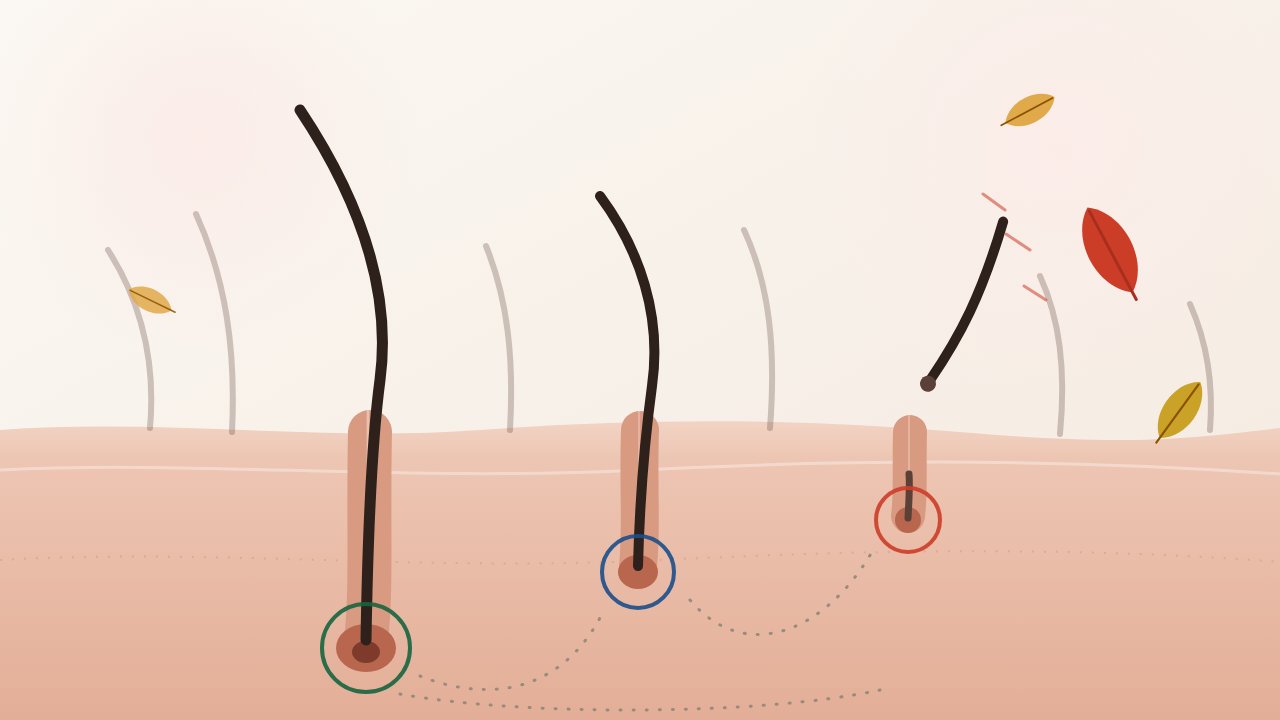
September, October… and suddenly there is more hair in your brush, in the shower or on your pillow. Dermatologists know this pattern well: most of the time, this shedding is seasonal and temporary, and the hair grows back. Here is how to recognise it, when to see a doctor and what your GP can check.
How many hairs do we normally lose a day?
Losing hair every day is normal: on average we shed 50 to 100 hairs a day, often without noticing. Hair loss is considered abnormal when you regularly lose more than 100 hairs a day.
How does the hair growth cycle work?
Each hair lives its own life, independently of its neighbours: that is why we never lose all our hair at once. Every hair goes through three phases.
- Phase 1 · anagenGrowthThe hair grows for several years, about 4 years on average. This applies to 85 to 90% of hairs.
- Phase 2 · catagenTransitionA short phase in which the root stops making the hair. Only a few hairs are at this stage.
- Phase 3 · telogenRest, then sheddingThe hair stays in place for about 3 months, then falls out and makes way for a new hair. About 1 hair in 10 is resting.
Remember this delay: when an event suddenly pushes many hairs into the resting phase, the shedding only shows 2 to 3 months later. Doctors call this telogen effluvium: diffuse shedding, sometimes alarming, but usually reversible.
Why do we lose more hair in autumn?
This seasonal rhythm has been measured. Dermatologists in Zurich analysed the hair of 823 women over 6 years: the share of resting hairs was highest in summer and lowest at the end of winter (Kunz et al., 2009). Given the 3-month delay, shedding becomes more visible at the end of summer and in autumn. Another team studied Google searches for hair loss in 8 countries from 2004 to 2016: in every country, searches were higher in summer and autumn (Hsiang et al., 2017). The exact reason is still unknown.
- SummerMore hairs at restThe share of hairs in the telogen phase reaches its peak.
- Late summer and autumnThe shedding showsAbout 3 months later, these hairs fall out.
- WinterBack to calmShedding slows down; the share of resting hairs is lowest at the end of winter.
Key points
Seasonal shedding is diffuse (all over the head, with no bald patches), temporary (usually a few weeks to a few months) and reversible: the hair grows back, although it can take several months to regain your usual volume.
When should you see a doctor?
Autumn shedding usually needs no treatment. Do talk to your GP, though, if you recognise one of these situations:
- shedding that has lasted more than 3 months, or is getting worse;
- bald patches;
- a widening parting, thinning on top of the head or hair that is getting finer;
- in men, temples that recede further or a crown that is thinning;
- a scalp that itches, turns red or becomes scaly;
- severe tiredness, heavy periods or rapid weight loss;
- pregnancy, a recent birth or a new medicine;
- in recent months, an illness with fever (flu, COVID…), an operation or major stress.
Important
Never stop a treatment on your own: talk to your doctor first. Taking a “hair” supplement? Mention it before a blood test: at high doses, biotin (vitamin B8) can distort some results, including thyroid tests.
What are the most common causes?
The season is not the only explanation. These are the leads your GP looks into.
| Lead | Clues | What we check |
|---|---|---|
| Seasonal shedding | Clues Late summer, autumn; diffuse shedding; you feel well | What we check An examination, often nothing more |
| Shedding after a shock | Clues Fever, COVID, surgery, childbirth, dieting or stress 2 to 3 months earlier | What we check Your recent history |
| Iron deficiency | Clues Tiredness, heavy periods, a diet low in iron | What we check Full blood count, ferritin |
| Thyroid | Clues Tiredness, feeling cold or palpitations, weight changes | What we check TSH |
| Pattern hair loss | Clues Widening parting, receding temples, finer hair | What we check A scalp examination |
| Alopecia areata | Clues Round or oval bald patches | What we check An examination, specialist advice if needed |
| Irritated scalp | Clues Itching, redness, scales | What we check An examination, sometimes a sample |
Iron: a common deficiency that is easy to check
The exact role of iron in hair loss is still debated, but a deficiency is easy to detect with a blood test (full blood count and ferritin, which reflects your iron stores) and can be corrected. Ferritin rises during an infection or inflammation, so a “normal” result does not always rule out a deficiency: your doctor interprets it.
The thyroid
An underactive or overactive thyroid can cause diffuse hair loss. The first test is TSH, the hormone that controls the thyroid (see our article on hypothyroidism).
Vitamins and supplements: with caution
Low levels of vitamin D or zinc are sometimes found in people with hair loss, but we do not know whether they cause it, and the evidence that a supplement makes hair grow back remains weak. Your doctor only tests them if your situation calls for it. Without a proven deficiency, iron, vitamins and “hair” supplements are usually pointless (see also our article on vitamin D in winter).
Pattern hair loss (androgenetic alopecia)
This is the most common cause of lasting hair loss, in men and women alike: the hairs gradually become finer. In men, the temples recede, then the crown thins; in women, the top of the head thins and the parting widens. Treatments exist, such as minoxidil as a lotion or foam, and finasteride for men: they work better when started early, and only for as long as they are used.
Alopecia areata and scalp conditions
In alopecia areata, the hair often grows back by itself within a few months, but medical advice is useful. Itching and scaling suggest seborrhoeic dermatitis, psoriasis or tinea capitis, a fungal infection treated with medicine taken by mouth.
What can the medical centre do for you?
At Maison Médicale Parc Astrid in Anderlecht, your GP looks for the cause of your hair loss with you, in French, Dutch, English or Turkish.
- The right questions. Since when? All over or in places? What happened in the previous 3 months? Your periods, your diet, any family history.
- A scalp examination. Where the hair is falling out, patches, redness, scales, how fine the hair is.
- The pull test. The doctor takes a small lock of about fifty hairs between the fingers and pulls gently. If more than a few come out (in practice more than 4 to 6), the shedding is active. It is quick and painless.
- A blood test, if useful. There is no standard “hair panel”: tests are chosen according to your answers and the examination. Most often a full blood count, ferritin and TSH; depending on your situation, vitamin D, zinc, vitamin B12 or folate. Our nursing team takes the blood sample at the practice or at your home and sends it to the laboratory.
- Your results explained, and follow-up. Your doctor explains the results, treats the cause if there is one, suggests a check-up and, if needed, asks for a dermatologist's opinion.
For registered patients: no payment at the consultation; your health insurance fund pays the practice a monthly flat fee (see how the flat-rate system works). Not registered yet? See the new patient page.
What about PRP for hair?
PRP, or platelet-rich plasma, involves taking a little of your blood, spinning it in a centrifuge to concentrate the platelets, then injecting this plasma into the scalp. It has mainly been studied in pattern hair loss. Recent reviews of the studies show an average gain in hair density, but with results that vary widely between studies, protocols that are not standardised (preparation, number of sessions, follow-up) and a level of evidence rated as low.
Above all, PRP is not a treatment for seasonal shedding: it settles on its own and the hair grows back without treatment. When hair is falling out, the first step is always to look for the cause.
Dr Selim Zengin, a GP at the medical centre, also practises scalp aesthetic medicine, including PRP, in a separate practice outside the flat-rate system: Zen. Médecine Esthétique.
Sources
- Kunz M. et al. – Seasonality of hair shedding in healthy women complaining of hair loss, Dermatology (2009)
- Hsiang E. Y. et al. – Seasonality of hair loss: a time series analysis of Google Trends data 2004–2016, British Journal of Dermatology (2017)
- Hughes E. C. et al. – Telogen Effluvium, StatPearls (updated 2024)
- Phillips T. G. et al. – Hair loss: common causes and treatment, American Family Physician (2017)
- American Academy of Dermatology – Do you have hair loss or hair shedding? (accessed 2026)
- Gezondheid en Wetenschap – Haaruitval (2026)
- Kieling L. et al. – Is autologous platelet-rich plasma capable of increasing hair density in patients with androgenic alopecia? A systematic review and meta-analysis of randomized clinical trials, Anais Brasileiros de Dermatologia (2024)
- Georgiadis J. et al. – Platelet-rich plasma for androgenic alopecia, American Family Physician (2022)